

Filed under Articles, Photos, Selected Features

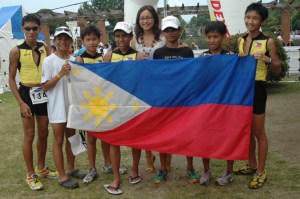
Pinoy SuperTriKids participate in World Kids Triathlon and Sports Summit in Japan!
The SuperTriKids’ participation in the World Kids Sports Summit and the World Kids Triathlon in Yokohama was an invaluable and enriching experience for each and every one of them. The seven boys and six girls all came home more motivated about training for and racing in international level competitions. Akira Michiko Sam from Davao was 6th in his wave and Gabrielle Allen Santiago of Laguna was another standout among the boys, placing 7th in his category. Teri and Andie Santos from Westgrove also did well among the girls, placing 6th and 8th, respectively. Most of their teammates where also competitive enough to stay in the middle to upper end of their pack in their first-ever international outing, which included hundreds of participants from countries like the USA, Ireland, Israel, Japan, China, Korea, Singapore, etc.
Here are some quotes gathered from the kids and parents:
Santos girls: “Our ultimate objective was to give it our best shot, and I honestly believe we did.”
Larry Ocampo: “It was a life-changing experience for Javi. He had to be disciplined in training and studying prior to the trip, and while in Japan, it was great for him to befriend kids from around the world and race at a higher level. He is determined to improve and return as a faster triathlete. As a parent I am very happy to see Javi’s discipline, confidence, social skills, and determination to be better get a major boost as a result of his participation.”
Alex Sam: “Both the summit and the triathlon were good exposure for the kids not only to different issues regarding the environment and how they can help in their own small way, as well as to other kids doing the same sport which serves as a confidence builder to make them strive more for their next events. The kids are now looking forward to more events like this and are excited to compete with other nationalities in the future. Thanks to TRAP for giving the kids the opportunity to attend this event. Congrats Team Pinoy SuperTriKids.”
Mylene Mapa: “The coaches were very supportive and attentive to the needs of the team. Nacho enjoyed the camaraderie with his teammates, as well as the new friendships formed and the healthy competition with other athletes from different countries. It was a great learning experience!”
Thanks to: Senator Pia for sponsoring our use of training facilities!!! TIMEX for the watches and caps!!! Gatorade for the Drinks!!! TRAP for keeping the program going!!! IGE for the Uniforms!!! Sir Tom, Coaches Rick, Abet, Joel, Patrick, Paolo, and all the Parents who constantly support their kids to become better athletes!!!
Athletes:
Boys
Gabrielle Allen Santiago, Nacho Mapa, Javi Ocampo, Ralph Gonzales, Gene Paguia, Akira Michico Sam, Miguel Dizon
Girls
Joey Santos, Teri Santos, Andie Santos, Denise Faith Garcia, Tintin Manalo, Bea Salera

Filed under Articles, Coaching and Training, Race Report, SuperKids, Timex, Triathlon for kids
http://superkids.triathlon.org.ph/athletes.htm
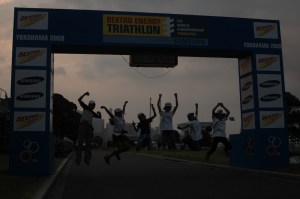
The following is a speech written by Josephine Santos, 13 years old and Team Captain of the Philippine Delegation of 6 girls and 7 boys to the first ever World Kids Triathlon Championships in Yokohama Japan on August 23, 2009. The kids have been preparing for this historic event and are pretty excited about the race. Read on…
Merit of Nurturing Physical and Mental Health through Sports
By: Josephine Marie M. Santos
Team Philippines
Good Morning fellow athletes! I am Josephine Marie .M. Santos , 13 years old, and captain of the Philippine team.
The Philippines , my country, is an archipelago like Japan . It is made up of 7, 107 islands—when it’s low tide. It is found in the Southeastern part of Asia right below Taiwan and east of Vietnam . The Philippines is rich in breathtaking landscapes such as the Chocolate Hills in Bohol , Mayon volcano in Bicol, and the Banaue rice terraces in Ifugao. It is blessed with beautiful beaches like the world-famous white sand Boracay beach in the South and Pagudpud in the North. Did you know that the Philippines is the 3 rd leading copper producer in the world and the 2 nd only to South Africa to gold production?
Some famous sports and games in the Philippines are basketball, badminton, and the local games. These local games like the patintero, piko (also known as hop-scotch), sekio, and sipa have been passed on from generation to generation. These games and sports are so popular in our country that you can see people playing them outside their houses, in schools and even on the streets. Take basketball for example, every community has a basketball court as a permanent fixture in their parks, plazas and even street corners! In school, local games are included in our Physical Education subject.
When I was 5 years old, my father taught me how to swim and trained me for an aquathlon. My first aquathlon race was a 100 m swim and a 500 m run. I started crying after the first 50 meters of my swim but my dad knew that physically I was capable of finishing the distance of the pool because he prepared me well that summer. He encouraged me to keep on going even if I was the only one left in the pool. I finished the swim and I started running. I started to feel good, and even overtook a bigger girl. I’m glad things turned out that way. What if he felt sorry for me, pulled me out of the water when I was crying and let me quit? Was it okay not to finish what you have started? What message would that have given me? There is a quote by John Collins, which goes: “you can quit and nobody else will care but you’ll always know” and I have learned to live by it.
Engaging in sports involves many aspects of the human being. On the physical side, as athletes, we have to keep our bodies in top shape by eating the right kinds of food and practicing self discipline in working out regularly, getting enough sleep and balancing our priorities. We build self-confidence, perseverance and discipline. It makes us goal-oriented, self-controlled, and we develop independence and assertiveness. Studies show that young people who participate in organized sports perform better in school, develop better social skills, are more team-oriented, and are generally healthier.
Engaging in sports offer opportunities for leadership, socialization and other important skills for handling success and failure. It teaches us to accept responsibility for our own behavior. When playing games, we learn how to follow rules. We understand that we need rules to keep things in order. Each person must follow the rules. Following rules mean that we respect the rights of others. We are able to compete, but we do so within a system wherein safety is considered and losers do not suffer too much. Sports also provide an outlet for releasing tension and anxiety. We are able to socialize with others more successfully.
The merit of nurturing physical and mental health through sports is that you have a positive outlook in life. You can develop a sound mind in a sound body. Having a physically and mentally healthy body can promote social well-being among young people. Everyone dreams of a better world, where there is peace on Earth and goodwill to all. Friendship breeds camaraderie, a common bond which unites people of different experiences, culture, and race.
You should have a balanced physical and mental capacity so that we never give the excuse: “the spirit is willing but the flesh is weak”. Sports not only take care of the body but also the spirit. Since we, the youth are the future, healthy kids mean a healthy world.
Engaging in sports prepares us for life. Life is tough. Sports make us tougher.
Thank you.


Filed under Articles, Selected Features, SuperKids, Triathlon for kids
 Cover Story
Power Woman
By Aries Espinosa
Philippine Daily Inquirer
First Posted 03:14:00 03/23/2008
MANILA, Philippines – In recent years, the high walls that surround what has always been described as a “man’s world” have slowly been chiseled away, thanks to women who will not be boxed by tradition. These days, people no longer do a second take when they see women cab drivers, welders, soldiers, scientists and top level politicians.
But nowhere is the concept of woman empowerment more apparent—and more challenged—than in the world of sports. By sheer bulk and brawn—nature and testosterone at work—as well as constant practice under the approving gaze of a male-dominated world, men’s winning performance has set the gold standard for athletics. For the longest time, men have been believed to be the stronger sex.
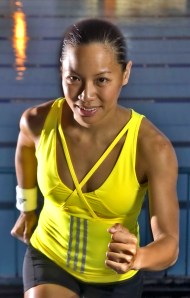
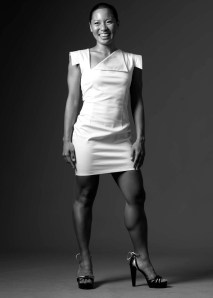
Well, tell that to the Marines. Better yet, tell that to Ani Karina de Leon, multiple National Triathlon champion, who last Feb. 23 again emerged from the box labeled “petite, fragile woman inside, handle with care,” and emerged victorious in the Ironman triathlon in Langkawi , Malaysia .
Competing among a field of 700 triathletes, 22 of them fellow Filipinos, De Leon swam 3.8 km, biked 180 km, and ran 42 km for a back-breaking, lung-busting, muscle-tearing 12 hours, 21 minutes and 17 seconds, to cross the finish line first in her age category (30-34), leaving many of the supposedly stronger men eating her salty dust.
More importantly, De Leon’s victory earned her the right to represent the Philippines in the mecca of triathlons: the Ironman Hawaii in Kona this October. “I’m the first ever homegrown Filipino in history to qualify in Hawaii,” she says with justifiable pride. (Take that, you chauvinist iron man!)
And there’s no doubt as to her gender, either. This triathlete may swim, bike and run like Mars, but she’s got a soft spot when it comes to matters of the heart. In fact, she admits to a budding romance with another triathlete—a foreign male—but ssssh, mom doesn’t know just yet, she confesses sheepishly. Alright, we can print that, she says, “because I’m about to tell her anyway.”
That’s all in the future though. Right now, what she’d like to tell the world is how she started on the road to Langkawi, and eventually, to Hawaii.
It all started about 21 years ago, when she was 12, De Leon reveals. “I began as a gymnast, then took up swimming when I was 14 at the UP Integrated School.” Her coach and swim buddies apparently noticed her all-around strong physique and encouraged her to run and bike as well, as a way of “cross training” for her main sport of swimming.
In 1994, when she was 19, she joined her first triathlon, a “beginner’s” distance of 1.5 km swim, 40-km bike, and 10-km run. “I was traumatized after that,” she laughs, “and I didn’t join another triathlon until 2000.”
What actually kept her busy during that time was college. She concentrated on finishing her Interior Design degree in UP Diliman and passing her board exams. As an artist De Leon also painted, and was already working for an interior design firm when competitions beckoned once more.
She joined the national team from 2000 to 2006. “At first, my life was like 70 percent devoted to career and 30 percent to the sport, but then the ratio just slowly swung in favor of the triathlon side. Now, my life revolves 100 percent around the sport,” she explains.
More like 120 percent, if you look at De Leon’s typical week. That’s because aside from training her already well-conditioned body (read: 12-percent body fat) for upcoming triathlon events this year, she also trains the next generation of triathletes.
De Leon runs a race series for children 15 years old and below for the Superkids Youth Development program of the Triathlon Association of the Philippines (www.triathlon.org.ph, click on the Superkids link).
“More than just developing their skills and preparing these children physically for multi-sports such as triathlons, this program also develops their confidence to face life as a whole,” she explains.
De Leon also manages to find time to run the Pinay in Action race series and fitness programs. Pinay in Action, as described in http://www.pinayinaction.com, was “created primarily to uplift the lives of the Filipina…to empower women and girls by providing venues for a healthier lifestyle and tools and information for a better future. Organized by Senator and fellow triathlete Pia Cayetano, Pinay in Action’s principal advocacies include a year-long program that involves conducting running clinics nationwide for public schoolgirls (Check out pinayinaction.com).
“We’re trying to remove the typical stereotype of women as being emotionally and physically weak, using the sport of running as our main medium to get the message across,” stresses De Leon.
Actually, De Leon and her family ARE the message. Older sister Sinag is considered one of the female pioneers of triathlon in the country. Younger sister Daniw has already begun participating in run races, and 12-year-old niece Raya has already started doing triathlons.
Mom Anna Leah Sarabia, a known advocate of women’s empowerment, whom De Leon ironically describes as “not having a single thread of athleticism in her body,” serves as her greatest inspiration.
“She has consistently shown strength of character from the time I could remember, up to now. She has always allowed us do our thing, while leading by example,” the daughter muses.
But De Leon is now in lonely territory, being the only homegrown Pinoy to compete in the Ironman Kona in Hawaii this October, an event that only about six percent of all triathlete applicants worldwide can get to start in, much less finish. A lifelong dream for this triathlete, the Ironman Hawaii will test every inch of what De Leon has become, and what she has become, she says, has been the result of thousands of decisions made every single day of her life. These are decisions, she proudly declares, that she has made herself.
With such ironclad determination and character, who can doubt that De Leon is made of sterner stuff? Alas, ladies, the IronWoman cometh.
Filed under Articles, Selected Features














 Filipina Ironwoman