Category Archives: Articles

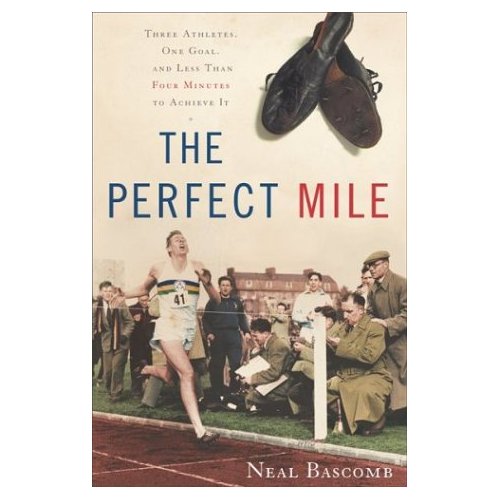
Book Review: The Perfect Mile

Book Review: The Perfect Mile by Neal Bascomb

Ani Karina S. de Leon


For those of us living in a country wherein the metric system is the standard for measuring distance, we may not have any idea nor even care about the significance of the mile in the history of athletics.   Only well informed or serious runners would probably be able to give you the exact number for determining whether you fall into the category of great runner or not.  And that, of course, is four minutes: to this day, it is still the yardstick for separating the truly fast from the average miler.

 the perfect mile

Not too long ago, May 6, 2004 to be exact, the world of athletics celebrated the 50 year anniversary of the first moment any individual was able to break the four minute barrier.  That honor goes to Sir Roger Bannister from the UK. 


The author, Neal Bascomb, gives the reader a remarkable historical backdrop of running during that era, including the frustrating politics, controversies on pacing, timing, and the influence of certain personalities like the famous athletes and coaches of that time.


The book revolves around three main characters and not just around Roger Bannister though, as the piece is generally about the race to break the 4minute mile, which apparently was a huge and almost impossible goal to achieve then.  The struggles and successes of John Landy of Australia and Wes Santee of the USA are vividly recounted as well, and their personal lives only add more color and drama to the already thick plot.


It is inspiring to say the least, and only goes to prove that human beings are capable of realizing their full potential if they are determined enough.  I will also never think of the mile run in the same way again.

Leave a comment

Filed under Articles, Review, Running

Fitness First triathletes first again

Fitness First Team Combat: Me, Ige, Mark, Dane, Eric

Fitness First Team Combat: Me, Ige, Mark, Dane, Eric


Fitness First triathletes first again
Updated May 24, 2009 12:00 AM
MANILA, Philippines – Team Combat of Fitness First, led by former national women’s triathlon champion and recent Ironman Hawaii finisher Ani de Leon and teammate Dane Cantwell, emerged runaway champion in the team event at the recent 16th Subic Bay ITU-International Triathlon.
De Leon submitted a finishing time of 2:33.14 in the individual age group of the men’s division while Cantwell clocked 2:16.16 in the women’s division.
With the 2:23.27 of Fitness First country manager Mark Ellis and Eriberto Carandang’s 2:27:32 Fitness First had an accumulated time of 9:40:31. Polo Tri Zoomers was second in 10:07:04.
David Verlee clocked 2:24.00 to lead his group composed of Anthony Welsh, JonJon Rufino, and Amanda Marie Carpo.
At third was last year’s team champion Herbalife with Ferdinand Catabian (2:16.56) at the helm together with Jojo Macalintal, Hiroshi Takei, and Reva Magno.
However, in the relay event, Herbalife retained the crown as its team of Michael Canillo, July Cagungun, and Orly Mariano combined for a winning time of 2:25.12.
The visiting Triathlon Association of Malaysia team, led by Stephanie Chok together with Gary Chong and Rikiguro Shinozuka, was second ( 2:25.54).
At third was the Camayan Ocean Adventure team (2:30.40).
The 13-15 age category was won by Bacolod’s John Rommel Uy followed by two Malaysian boys while Singapore’s Phan Yong Tin Joy copped the girl’s plum.
Spring junior and adult champions were Hong Kong’s Cheung Tsz Hei, Johanna Pe Benito, Jonjon Rufino and Stephanie Chok.
Top overall finishers in the women’s individual age group competition were De Leon, Carpo (2:39.48) and 35-39 age group champion Rizzo Tangan (2:43.05). Runners-up to Cantwell in the men’s side were Catabian and former national team member Noel Salvador (2:20.44.1).
Other age group winners in the event sponsored by SBMA, Speedo, Gatorade, PSC, David’s Salon, Globe Telecoms, Fitness First, Asian Center for Insulation, Vitwater, Sunkist, and Rudy Project, were Jefferson Tabacon (17-19,  2:43.59), Emmanuel Rodil (20-24, 2:38.17), duathlete Augus Benedicto (25-29, 2:23.03), Cantwell (30-34), Salvador (40-44), Welsh (45-49, 2:33.05, Alvin Alindogan (50-54, 2:31.26), Dr. Oscar Escudero Jr., (55-59, 3:03.45) and Brigilio Balaba (60-over, 3:25.17).
The women’s side had De Leon taking the 30-34 crown, Fiona Ottiger, 40-44 in 2:50.03, and Tangan, 35-39.
Sen. Pia Cayetano, a staunch supporter of triathlon, placed second in her age group with a time of 3:02.40.
“This was the biggest field ever in the team event of the Subic Bay International Triathlon and it shows the growth of triathlon as a serious sport in the country, “said TRAP president Tom Carrasco Jr. after the race that had Philippine STAR, DZSR, and Solar Sports together with radio sponsors – Jam 88.3, Wave 89.1, Magic 89.9, 99.5 RT, and 103.5 Max FM.


1 Comment

Filed under Coaching and Training, Race Report, Selected Features

The Warrior Mind: Developing Mental Toughness in Sports

The Warrior Mind:  Developing Mental Toughness in Sports 

By Ani Karina Sarabia de Leon

Whatever the mind can conceive and believe, it can achieveNapoleon Hill 

 The difference between ordinary and extraordinary is that little extra- ITU New Plymouth Race Video

Nothing is so common as unsuccessful people with talent. All they lack is determination- Nick Bolletieri

Mens sana in corpore sano (a healthy mind in a healthy body)- famous Latin quotation, often translated as “A sound mind in a sound body.” From Satire X of the Roman poet Juvenal.

20d office 257

What makes a great athlete?  Is it skill and technique? Endurance and stamina? Speed and strength?  When we train, we think about these things, and inside this magazine alone, you will find numerous articles which will help you develop these.  With these important components present and working well together, surely this will easily translate to success in your chosen sport, right?  Well, you need one more key ingredient.  You need mental strength.

Oh dear, you say, that’s it for me then, because I’m just not that type of person.  Good news—you don’t have to be a navy seal to possess this quality.  You can train your mind to get into shape just like your body. Here’s how.

1. Have Intrinsic Motivation.

Sports psychologists say that mentally tough athletes typically exhibit “intrinsic motivation.”  These people don’t need to be told what to do; they will go ahead and do it on their own.  Find that fuel that will fan your inner fire, everyone has something different and personal.

2. Get into “The Zone.”

You’ve heard so much about this particular “zone” that athletes get into when they’re performing that it seems cliché to write about it.  But it’s real and present in the world’s top players.  When everybody else is panicking and buckling under pressure, it is extremely important to stay calm and focus on the job at hand.

3. Stay Positive.Langkawi Race Day Shots 2009 (13)

Eliminate all your doubts and self-blocks.  The number one hurdle to success that most people have is caused by all the negativity clouding their brains.  Replace all these with positive and hopeful thoughts, and believe in them.

4. Practice Good Self-Talk.

Having a coach is crucial, but the person you are with all of the time is yourself.  Say things to yourself such as, ”you are going to do so well, and it’s gonna be an excellent day for you,” or if you make a mistake, instead of kicking yourself about it, say something like,” that’s okay, no big deal, you’re going to recover and make a good comeback from that.” It takes practice, but when the going gets rough, this tool is invaluable.

5. Visualize.

Joe Stankowski, a former powerlifting and strongman competitor, once said, “your set should be mentally done.” Imagine each step that you will need to take, the surroundings, the smell, what you will be wearing, how you will feel and look upon creating your movements, and rehearse them in your mind. “Because it’s already been done in your mind,” says Stankowski, “all you have to do is repeat it with your body.”

6. Meditate.

Just like a dirty engine that needs to be overhauled, the brain needs to detoxify and let go of all the junk inside it for it to be functioning properly.  Meditation is a technique which has been employed by many successful people for thousands of years to do just that. It fortifies your mental well-being, enhances mental clarity, reduces stress, and generally relaxes you.

7. Learn to deal with uncomfortable situations.

Get real; you can’t expect to achieve magnificent results by sitting in front of the TV.  You know you gotta deal with some challenges and sweat it out.  Once you’ve mastered the ability to troubleshoot and practice critical thinking, you will find that you can face a good number of difficult situations head-on.

8. Always be prepared.

Be a planner.  And to go even further than that, if your plan doesn’t fall through, have a back-up plan.  More than anything, if you are armed with good planning and preparation, then you will have peace of mind come competition day.

9. Don’t be afraid of failure. 20d office 065

And finally, after all of the above, the best athletes don’t overthink everything.  They just do it, like the famous ad says, and they have no fear when they do (another ad).  I mean, what’s the worst thing that could happen? And if it does happen, is that going to be so bad?  So aim high, believe in yourself, and get back up if you fall.  Chances are, you’ll be a much better person for it.

Leave a comment

Filed under Articles

Marie Claire Magazine: HONORING THE PHILIPPINES’ 10 WOMEN OF THE WORLD 2008

HONORING THE PHILIPPINES’ 10 WOMEN OF THE WORLD 2008

Ani Karina S. de Leon

MC CoverProgram Manager, Pinay In Action Women Empowerment through Fitness Program, Office of Senator Pia Cayetano. www.pinayinaction.com

Program Manager, SuperKids Triathlon Youth Development Program, Triathlon Association of the Philippines.  www.superkids.triathlon.org.ph

 1)       To what or to whom do you attribute your success and why?

Growing up in a very dynamic household greatly contributed to that. It was generally frowned upon at home to be idle, so we would be either drawing, playing the piano, writing homemade books, etc…watching tv definitely didn’t count as an activity and was highly discouraged!  My parents, even now, are always spearheading all sorts of projects which have a positive impact on society and culture, and this kind of self-confidence and awareness—that I have to be involved in endeavors that make a difference—are ingrained in me as a result of this.  They already taught me how to have a good work ethic, and it was just a matter of finding something which I could be passionate about…which turned out to be sharing my love for sports to others and encouraging people to have a fit and healthy lifestyle.

 2)       Please describe the instance (when, where, what year, what occasion, who were with you) when you felt you had achieved success.

Although I would like to emphasize the fact that there have been many significant moments of triumph for me along the way, I certainly felt that when I won my category in the Ironman Malaysia Triathlon in February this year, everything just came together.  I was competing as part of a big Philippine contingent, and representing the country always makes me give more of myself.  I was crying when I crossed the finish line because I knew I had won, and it was perfect because I finished at the same time with two of my male training partners, Maiqui and Mark.  We had a big hug and even for weeks afterward I felt such relief and happiness that all my years of dedicating blood, sweat, and tears to the sport were finally rewarded—my win had entitled me a slot in the Ironman World Championships in Hawaii.

 3)       What do you consider your greatest achievement? Why?

It’s still a work in progress, but I genuinely believe that my own successes partnered with the successes of the women and juniors whom I coach are going to be my greatest achievement.  And this doesn’t mean just in the athletic arena.  When I coach or hold clinics I always try to convey the message that success in sports or simply possessing good physical fitness will affect all the other aspects of your life positively. When I win, I become more credible to the people who look up to me, most important of whom are the kids and young women.10 Women of The World Toast (1)

 4)       If you could change one thing about yourself, what would it be and why?

 I like to be involved with so many things, and since I like to work on my own, most of the time I end up with so much backlog!

 5)       What else do you want to achieve in the next five years? Why?

 Personally, I’d like to see how far I can go with racing this specific distance for triathlon, which is the Ironman (3.8km Swim, 180km Bike, & 42km Run).  I have only started to race this long and I think I like it much more than short distance racing. 

 In terms of the  programs I am involved in, Pinay In Action and SuperKids, I’d like to see them evolve and become highly successful.  I am hoping to have more squads located all over the country, preferably with more like-minded coaches helping me carry it out.

6)       What, in your opinion, is the greatest challenge Filipinos face right now?

The great thing about us Pinoys is that we are extremely resourceful, and that is how we have been getting by so far.  But I think to be even competitive internationally, we need a better roadmap, something that we can build on long term—and more importantly a way to implement these plans. 

7)       Which historical figure do you most identify with? Why?

In Philippine History I would have to say Gabriela Silang.  She led an army of men without fear and the fact that she was a woman was inconsequential to her.  The amazing thing for me is that the Katipuneros truly followed her, which is hard for most men to do even up to today, and that only means that she must have been a genuine person of influence and a force to be reckoned with.

8)       What do you like most about your appearance?

I like the fact that I look really strong, and that I can actually back it up! My physique is something that takes discipline to maintain, and that in itself is a quiet pronouncement of my character.

9)       If you could change one thing about yourself, what would it be?

When it comes to certain things (i.e. boring but necessary paperwork) I tend to procrastinate.

10)   What is your most treasured possession?

Right now it’s definitely my CEEPO Time Trial Killer bike. They made a custom-designed frame for me courtesy of Jerry Santos.  It goes wherever I go!

11)   Who are your favorite writers? Have any of them influenced the way you think and act? How?

I tend to gravitate towards autobiographies of sports heroes, because I can certainly relate to and learn from them.  Some of my favorites are Lance Armstrong’s “It’s Not About the Bike,” Dean Karnazes’ “Ultra Marathon Man,” Lynn Cox’s “Swimming To Antarctica,” and “The Perfect Mile” by Sir Roger Bannister.  Right now I’m reading Summer Sanders’ “Champions are Raised, Not Born.”

12)   What motto or creed of life do you live by?

Life is a great adventure.  Don’t be afraid to take risks.  Staying in one’s comfort zone breeds mediocrity.  Okay, those were three mottos already, haha.
Leave a comment

Filed under Selected Features

Alternatives to Running: Being Pro-Active When Injury Strikes


aqua runnerAlternatives to Running: Being Pro-Active When Injury Strikes

Let’s face it, whether you’re a serious athlete or a casual gym-goer, you probably don’t like being sidelined with injuries. We’re happiest when we get to play.  However, experts advice you not to ignore your injury by training right through it.  It’s not the end of the world though, and there are other exercises you can do to stay in shape and avoid further stressing out your pain.

  1. The Stair Climber

Strengthens leg muscles, tones buttocks and provides a good all-over aerobic workout. Technique is more important here than on any other machine, otherwise you are wasting your time!  Don’t support yourself on your elbows or lean in too much. Hold on for balance, still stand fairly upright. These machines are relatively easy on the joints, but people with knee problems should talk to a doctor beforehand.

  1. The Elliptical Machine

With the elliptical, your feet never leave the footpads—and this is good because that means it’s low impact.  It is still weight-bearing though, and this helps maintain and improve bone density.  It has a continuous and fluid movement which takes out the stress on your joints.  It is a full body workout with great cardiovascular benefits.

  1. Cycling:  Biking Outdoors, Spinning Classes, and Recumbent and Upright Cycle Machines

Biking outdoors, aside from being a great alternative to running, gives you so many other benefits, like experiencing great views, having fun on a group ride, and feeling the wind on your face.  It’s gentle on the knees and can help you burn a lot of calories.  You’ll develop your quadriceps muscles, gluteal muscles, and hamstring muscles, all of which are necessary in running.  Most of the time though, urbanites find it much more convenient to bike indoors, to avoid uncomfortable weather, cars and pollution, dogs, and bad roads.  Among the indoor exercise bikes we have the Spinning Bike and the Recumbent and Upright Cycle Machines.  The Spinning Bike is excellent because its geometry is very similar to that of a real bike, and the best way to enjoy them is to sign up for spinning classes.  These classes are so popular because of the social atmosphere and having an instructor up front telling you what to do is easier and less boring than doing it alone.

  1. Walking

Even if you can’t run on the treadmill for now, there’s another way for you to use it—walk!  It will give you great aerobic fitness, done at moderate and high intensities.  You can even walk everyday if you want to, provided you alternate your efforts between easy and hard.

  1.  Circuit Training

This is a great routine which combines both cardiovascular fitness and resistance training.  In the gym, you move from one exercise station to another within a span of 30-90 seconds.  You can use a wide variety of equipment such as weights, dumbbells, physioballs, medicine balls, ropes and surgical tubing, and machines.  One circuit can include 6-15 stations, and may be counted as one set, with the option of repeating the whole routine 2 or 3 times.

  1. Deep-Water Running

This is actually number one on my list, and it’s the only one that perfectly simulates running form.  There is no impact, it provides a great workout because of water resistance, and it’s good cross-training even if you aren’t injured.  Find a pool that is deep enough for you to run in without your feet touching the floor.  Invest in a good aquabelt to make your session easier.

Leave a comment

Filed under Articles, Running

Swim, Bike, Run + FUN = SuperKids!

SuperTriKids CDO 2008 (20)Swim, Bike, Run + FUN = SuperKids!

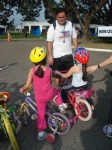
Looking for a cool activity for your little one?  Bored with the predictable offerings and sports clinics that are available year in and year out?  Well then, we have just the thing for you—SuperKids to the rescue!!!

What is SuperKids?


SuperKids is the youth development program of the Triathlon Association of the Philippines (TRAP), and endeavors to cultivate a dynamic multi-sport environment in the Philippines, appropriate for the development of growing children and adolescents, which will prepare them for life-long participation in multi-sport.  The program consists of races, training camps, lectures, demonstrations, and other training and educational activities for young multi-sport athletes, coaches, and parents.

 Where can I get more information?

You can visit our website at http://www.superkids.triathlon.org.ph

 Who can join?

Anyone aged 15 and below with knowledge of swimming, biking, and running for triathlons, swimming and running for aquathlons, and biking and running for duathlons.  Marshals are kid-friendly and will help any beginner and provide assistance when necessary.DSC02274

 Who can I ask for help with training and prepraration?

Coaches Ani de Leon and Rick Reyes of the TRAP junior development program.  You can email them via the website and ask for professional coaching advice.

  *The Triathlon Association of the Philippines officially launched the SuperKids Multisport Race Series last April 22, 2007 at Ayala Alabang Village in Muntinlupa City.

Leave a comment

Filed under Articles, Coaching and Training, SuperKids, Triathlon for kids

Danskin All Womens Tri 2006 Sandy Hook NJ

On September 17, 2006, I sent this email from New Jersey to some of my girlfriends back home in Manila:

Hi everyone!!!

Hope you had a good weekend! For those of you who raced, how was it??? As for my race I did ok, considering no training whatsoever for three weeks, what with my crash prior to coming here plus Arland’s group here always trying to show me all their hangouts, not to mention all the ice cream places haha…super “tapered” is what i would call it. I was able to place 10th overall–and this even though i and three other girls went off course because the marshals weren’t ready  for our arrival and were missing in their post.

But I don’t care about that tiny mishap…because man…this race was the bestest bestest ever!  I am so inspired, there were so many women, almost 2,000 and they came in all shapes and sizes.  No kidding, there were 200+pound females, cancer survivors, and a lot of 60+ yr olds doing it.  They were awesome.

I came into the race expecting to have fun because it was an all-women’s event of course, but i had some issues deep inside my head about being overweight, not being able to train partly because northwest airlines decided to leave my bike somewhere in Minneapolis and I only got it just a few days ago, far from feeling 100% kasi vacation mode, then I kept complaining to Arland because he entered me in the elite wave and I was feeling sooo unworthy of being in that category being in the condition that I was….and yeah, all of that crap that makes for a lot of negativity….and then I see these females, and all of a sudden i felt like such a drama queen.  And I hought–what the heck were you so worried about Ani???  I was humbled yet again, and I willingly accepted it.

I am really glad I joined.  I signed up originally because I wanted to emulate the race and put up something like it back home, and now I know I made the right decision.  This has got to be the best thing that ever happened to me in a long time.  Over the past few years I have gone through so many ups and downs, and now I feel so renewed, I am remembering why I love doing this–and everyday I just thank God that I am able to do it.

I was kinda getting tired of the usual racing scene over there already and now I have so many ideas that I am taking home with me.  If I could bottle up all the emotions I felt today and share it with you I’d be so happy.  I was racing and smiling and cheering loudly for everyone on the course all at the same time–because I wanted to do that, sure, and really because I had no choice but to respond to all of them doing the same thing for me.  Sisterhood and Positive, Loving Energy was the order of the day, and I soaked it all in.

I hope someday you guys could all join a race that would come close to this one.

Love Ani

Note: Within the same year, Pinay In Action was launched. I am so happy to have a local All Women’s Event alive and kicking in the Philippines, and even happier to be part of it. The pics here are from our recent All Women’s Run in Mall Of Asia, 2009.

Leave a comment

Filed under Coaching and Training, Race Report, Random Thoughts, Travel

The Inaugural Aviva Ironman 70.3 Singapore 2007: a milestone for Asian Triathlon

P8316958The Inaugural Aviva Ironman 70.3 Singapore: a milestone for Asian Triathlon


“Who says I can’t?”  This was the catchphrase of the TV ad which was aired repeatedly over a couple months in various cable networks internationally.  It showcased a handful of ordinary people who had a common goal: to test their mettle in the newest Half Ironman distance race in Asia. 


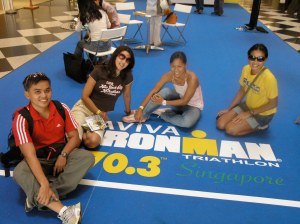
Last September, approximately 1,250 triathletes from all over the world congregated in Singapore, passing through the city’s popular landmarks such as East Coast Park, Marina Promenade, and the Esplanade.  With the help of Senator Pia Cayetano and our Pinay In Action project, I was lucky enough to be one of the competitors.  


I was in pretty good company—the Philippine contingent was, in fact, a perfect example of what the race organizers had intended to attract: triathletes from all walks of life who set out to challenge themselves.  Our representatives included the likes of business tycoon Fernando Zobel de Ayala, Senator Pia Cayetano, David Charlton of David’s Salon, individuals from Cagayan de Oro, Davao, some OFWs based in Singapore and neighboring Malaysia, and members of various triathlon clubs like Polo Tri, Fitness First, Team David’s Salon and Xycos, to name a few.

 703%20group%20pic

The Aviva Ironman 70.3 Singapore promised to be a truly unique destination race.  In the words of organizer Adrian Mok, “There are no other city Ironmans in the world – this is the only one. Others might start in the city but heads out of the city. This is more spectator-friendly as they are able to watch the action. We are especially proud of the cycling route as previously cycling on the highway was not allowed.”


Everybody was excited about the much hyped-up race but the question hung in the air whether the organizers could pull this off the first time around.  Having raced in Singapore repeatedly over the past couple of years, I was pretty confident they would.  But I still decided that I would reserve judgment until after the race was over.


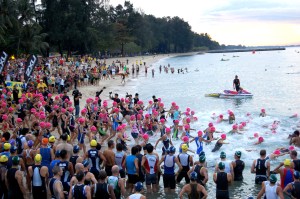
The 70.3 posed a challenging 1.9km swim leg, with the rough waters creating a sea of different colored swim caps constantly bobbing up and down the length of the East Coast. There were a significant number of worried expressions from the participants as they gazed into the chop, but thankfully the first portion of the triathlon, which consisted of only one big rectangular loop, went by without any mishaps. The run from the beach to the transition was quite a way, but it was flat and the ground was carpeted, so this wasn’t really a problem.  

 DSCF6170

The designated bike course was not demanding physically, but technically, there were a lot of narrow lanes and sharp corners, so this required our total concentration. The fact that the race was very well-attended did not help as well, and even though drafting (riding very closely with other cyclists) was not allowed, it was impossible to avoid it in some segments and from where I was I could see that a lot of the triathletes took full advantage of this!  We passed a lot of scenic spots though, and I particularly enjoyed it every time we were atop Benjamin Sheares Bridge.  After completing five laps and registering 90km on my bike computer, I wheeled my bike into T2, which was at the Champs Arena.  The volunteers were quite helpful, as they helped me park my bike and handed me my run bag immediately. 


The 21km run was flat all the way, and we ran along the tree-lined paths with relative comfort.  Aid stations were conveniently located 2km apart so the racers didn’t want for sports gels or water.  At last, the bright yellow finish arch beckoned us on the floating platform and we crossed it, weary but truly satisfied.  Who says we can’t?”  No one. No one at all.

Leave a comment

Filed under Articles, Coaching and Training, Race Report, Travel

Resistance Training for Endurance Athletes

Resistance Training for Endurance Athletes

By Ani Karina S. de Leon

Most endurance athletes have a very heavy training load, and a lot of the time, their career span greatly depends on their ability to stay away from injury and maintain a high level of fitness over prolonged periods.

Resistance Training

A lot of competitive coaches and elite athletes look to resistance training to aid them in this area, and here are some facts gathered from a study done by Jacques DeVore of Titan Sports Performance Center, as cited in his extensive paper, “Strength Training and Endurance Athletes: The Missing Link:”

1) Research shows that resistance training aids endurance athletes.
2) Properly managed resistance programs goal should be focused on power development.
3) Coaches should understand the correlation of resistance training protocols and the sports specific training required.
4) The ability of the athlete to produce higher overloads in sports specific training sessions is the biggest benefit for the endurance athlete.
5) Increased core strength and overall improvement in muscle imbalances helps prevent overuse injuries. This is in addition to the added benefits of power production from appropriate resistance training programs.  

IMWA 2007 360

From the items mentioned above, we can gather that resistance training is an effective tool for endurance athletes.  But it is very important to note that their studies also specify a certain type of resistance training suited for the said individuals.

So, what consists of a good resistance training program for someone involved in endurance activities?  Mr. DeVore goes on to conclude the following:

“The real measurement of a good resistance training program for a cyclist or other endurance athlete is that it creates a platform for the athlete to produce greater power output during sports specific training sessions.  This allows the athletes to have greater overloads in their actual sport specific training.”

Sounds really good, but how do we apply these theories and incorporate them into our routine?

Circuit Training

Good old circuit training, which dates back to the 1970s, have been greatly downplayed in the recent years, but unjustly so, in our opinion.  Circuit workouts are modest in length and they are beneficial not only for the muscular system but also for the cardiovascular system, and scientific research through the years has backed up these claims.  Individuals who were tested made progress with their VO2max values and treadmill endurance times.  They improved muscular strength, and since possessing this seems to decrease muscular fatigue during exercise, it allowed the athletes to exercise longer.

According to the authorities at Peak Performance lab, “the continuous nature of circuit training tends to keep heart rate and oxygen consumption high throughout the workout. You are always doing something, so the muscles keep using oxygen to furnish the necessary fuel, and the heart keeps pumping oxygen to the muscles. High heart rates and oxygen-consumption rates during workouts tend to heighten VO2max.”

Sample Workout

The following routine was developed by Peak Performance, and is perfect for endurance athletes.  It is an excellent workout in the sense that the athlete can perform it comfortably anywhere he/ she is training as there is no need for it to be done inside the gym.

Warm up with 10 to 15 minutes of easy jogging, swimming or cycling, and then perform the following exercises in order. Move quickly from exercise to exercise, but don’t perform the exercises themselves too quickly (don’t sacrifice good form just to get them done in a hurry). The idea is to do each exercise methodically and efficiently – and then almost immediately start on the next one.

1.  Run 400 metres at current 5-K race pace (if you’re a swimmer, swim 100 metres at high intensity; if you’re a cyclist pedal for 1600 metres at a high rate of speed)
2. Do 5 chin-ups
3. Complete 36 ab crunches
4. Perform 15 squat thrusts with jumps
5. Do 15 press-ups
6. Complete 30 body-weight squats (fast)
7. Run 400 metres at 5-K pace again (if you’re a swimmer or cyclist, see step 1)
8. Do 12 squat and dumbbell presses (with 10-pound dumbbells, or if outside the gym, use two equally-sized, filled up water bottles)
9. Complete 10 feet-elevated press-ups
10. Perform 36 low-back extensions
11. Do 15 bench dips
12. Complete 15 lunges with each leg
13. Run 400 metres at 5-K pace
14. Repeat steps 2-13 one more time (for two circuits in all), and then cool down with about 15 minutes of light jogging, swimming, or cycling.

 George Run

References:

1. Strength Training and Endurance Athletes: The Missing Link.” Jacques DeVore, Titan Sports Performance Center

2. Peak Performance Website.

3. “Resistance Training For Endurance Athletes.”  Mark Kovacs, High Performance Training.

Leave a comment

Filed under Articles, Coaching and Training

Swimming Without Lanes: Braving the Open Water

Singapore 70.3 2008 (41)

Swimming Without Lanes:  Braving the Open Water

By Ani Karina S. de Leon


I blame the Hollywood film Jaws for generations of petrified individuals who don’t even want to venture beyond waist-deep water while swimming in the ocean.  Make a quick survey and people will most likely state sharks as the reason for them not wanting to be more adventurous in the water and in the process enjoy a myriad of water sports and other delightful aquatic activities.  This is such a shame, because of all the open water racing I’ve done locally and internationally, I have yet to hear about a shark attack or even a shark sighting.

Having debunked that myth, I am not here to declare either that open water swimming doesn’t come with its own set of challenges, but armed with the proper tools and know-how, it can be one of the most fun things that you can learn to do.


Saltwater, Fresh-water, Pool water

Some important tips: Saltwater is denser then pool water or fresh-water, so you are actually more buoyant when you are in the ocean.  In other words, your body floats more easily, which is always a good thing!  Swimming in the ocean however, requires you to use a different technique, as the water is denser and thus will give you more resistance when you pull.  It can also be more turbulent, wavy, and sometimes extremely cold or warm, but for me that is all part of the package.  In general, it is a good idea to know a bit more about the environment you are swimming in and to try it out at least once before your event, ideally at around the same time as your race start.

1 (25)

The Waves Beckon 


Dive right into a systematic plan of action with the following pointers:


  1. Navigation.   Incorporate sighting into your swimming regimen, as you will definitely need to do a lot of it outside the pool.  Sighting doesn’t necessarily men lifting your full head and upper torso out of the water, as long as the waves aren’t strong and the water is calm, you can afford to lift it up only until the level of your eyes, make a quick sight of your destination point, and then bring your head back down again.  Every time you tilt your upper body higher means your lower body will sink, which directly translates to kicking more.  Find a good sighting rhythm, say, every 6 strokes, and practice to be comfortable with it.  As a group you can position turn around points like buoys or small rafts and bunch up together as if in a race.  This can also make your workouts less monotonous.
  2. Equipment. Sunscreen is a must, no if or buts about it.  Find a good swimsuit that will not cause too much drag, and this would mean it fits you snugly, nothing too loose for water to pass through as this will slow you down.  For training it is a good investment to purchase a durable fabric such as Speedo’s Endurance line, as this will last you for years if you take care of it properly.  For racing, a thinner and smoother surfaced suit like the Fastskin line is better as this will ensure better hydrodynamics.  Figuring out the pair of goggles that best suits you is priceless as you cannot afford them to come loose when someone kicks you in the face and you are in the middle of your race.  Different facial types prefer specific shapes and sized goggles, so don’t be afraid to try everything out in the store.  It is best to test them in the water of course, to make certain there are no leaks.  A lot of people also benefit from using lubricants like petroleum jelly to prevent chafing on certain friction points, the armpits for example.
  3. Entering and Exiting the Water.  A lot of races start off from the beach, and this requires running from sand to gradually or rapidly increasing water levels.  How does one determine at which point to stop running and where to start swimming?  The rule of thumb is that if the water is still below your knees it is still better to run, and when it is in between your knees and your waist you can start dolphining, and then when it is at torso level you can already start swimming.  Dolphining is a very very fast and efficient way to go through the water, and mastering little things like this could make or break your goal to stay with the pack initially.  To dolphin means to jump in a forward arch like movement the way real dolphins do it.  To exit the water, just reverse the steps above, so from swimming, you dolphin, then you start running in the water and onto the beach.  I must warn you that the change in body position from swimming (which is horizontal) to running (which is vertical) creates a sudden rush of blood in your system and might throw you off balance if you are not expecting it.
  4. Drafting.  Whether we like it or not, we are going to have to swim around people in a race, and a lot of times it could be frustrating not being able to settle into a pace that we prefer.  Eventually though, after the initial riot of the mass start, you will end up finding a couple of people swimming just a little bit faster than you and it is best to stay on their feet if your goal is to save energy.  The ideal spot is directly behind a person, although a significant advantage could still be gained from staying just bit behind where their arms finish off to the side.  Drafting behind people slower than you would make no sense, so always be aware if you are being smart or just being lazy.
  5. Group Training.  Pool swimmers used to having a nice still lane of their own can be momentarily thrown aback when faced with a mass open water start of, say, maybe five hundred people, and this too, can be prevented.  A couple of simulated workouts with friends will help familiarize you with the intensity of the actual race start.  Even if there are only five of you, for example, just make sure to stay in one lane and try to practice swimming together.  Do a couple of laps at high intensity and a couple of laps at slower paces, just to get the hang of it. 

1 Comment

Filed under Articles, Coaching and Training, Swimming